Example 2: Two arm | Fixed design | Two correlated continuous endpoints | t-test
example-2.Rmd
# Core package that provides Timer, Population, Trial, deterministic_schedule, add_timepoints, ...
library(rxsim)

# Utilities
library(dplyr)
#>
#> Attaching package: 'dplyr'
#> The following objects are masked from 'package:stats':
#>
#>     filter, lag
#> The following objects are masked from 'package:base':
#>
#>     intersect, setdiff, setequal, union
library(MASS)   # for mvrnorm (simulate correlated endpoints)
#>
#> Attaching package: 'MASS'
#> The following object is masked from 'package:dplyr':
#>
#>     select
Many trials evaluate co-primary or key secondary endpoints simultaneously. Ignoring endpoint correlation when planning a study leads to incorrect power estimates. This example shows how to simulate two correlated continuous endpoints (e.g., a primary efficacy score and a key secondary biomarker) and apply multiplicity adjustment via Holm’s procedure. See Example 1 for the simpler single-endpoint baseline.
Unique focus: correlated endpoints via
MASS::mvrnorm, Holm correction, joint vs marginal rejection
rates as correlation varies.
Common scaffolding (packages, scenario declaration, and
replicate_trial() pattern) follows Example 1; this vignette only expands the
parts that change for correlated multi-endpoint analyses.
Scenario
We consider a two-arm, fixed design with two correlated continuous endpoints per subject. A single analysis fires at full enrollment.
# Total target sample size
sample_size <- 100

# Arms and allocation (balanced)
arms       <- c("pbo", "trt")
allocation <- c(1, 1)

# Endpoint model parameters
# Endpoint correlation structure (common across arms for simplicity)
rho  <- 0.60            # correlation between endpoint1 and endpoint2
sd1  <- 1.00            # SD of endpoint1
sd2  <- 1.00            # SD of endpoint2

# Mean structure per arm
mu1_pbo <- 0.00         # Control mean for endpoint1
mu2_pbo <- 0.00         # Control mean for endpoint2

# Treatment effects (mean shifts)
delta1  <- 0.30         # Treatment - control difference for endpoint1
delta2  <- 0.20         # Treatment - control difference for endpoint2

mu1_trt <- mu1_pbo + delta1
mu2_trt <- mu2_pbo + delta2

# Construct covariance matrix
Sigma <- matrix(
  c(sd1^2, rho*sd1*sd2,
    rho*sd1*sd2, sd2^2),
  nrow = 2, byrow = TRUE
)

scenario <- tidyr::expand_grid(
  sample_size = sample_size,
  allocation = list(allocation),
  rho = rho,
  delta1 = delta1,
  delta2 = delta2
)

enrollment_fn <- function(n) rexp(n, rate = 1)
dropout_fn    <- function(n) rexp(n, rate = 0.01)
rho = 0.60 represents a moderate positive correlation
between the two endpoints - plausible when both reflect the same
underlying biological process. The covariance matrix Sigma
is constructed from the marginal SDs and correlation using the standard
identity cov(y1, y2) = rho × sd1 × sd2. Treatment shifts are delta1 =
0.30 SD for the primary endpoint and delta2 = 0.20 SD for the secondary,
reflecting a scenario where the primary endpoint is more sensitive to
treatment.
Populations
For each arm we simulate two correlated endpoints
per subject using MASS::mvrnorm. In this vignette, that
arm-specific generator is the custom data generating
model for endpoint behavior.
# Create closure to capture parameters
mk_population_generator <- function(mu_y1, mu_y2) {
  function(n) {
    xy <- MASS::mvrnorm(
      n     = n,
      mu    = c(mu_y1, mu_y2),
      Sigma = Sigma
    )
    data.frame(
      id = seq_len(n),
      y1 = xy[, 1],
      y2 = xy[, 2],
      readout_time = 1
    )
  }
}

population_generators <- list(
  pbo = mk_population_generator(mu1_pbo, mu2_pbo),
  trt = mk_population_generator(mu1_trt, mu2_trt)
)
MASS::mvrnorm draws n samples from a
multivariate normal with the given mean vector and covariance matrix
Sigma. The closure pattern
(mk_population_generator) captures the arm-specific means
at definition time, so each call to
population_generators$pbo(n) or
population_generators$trt(n) produces data under the
correct arm parameters. Endpoint correlation flows entirely through the
shared Sigma matrix - changing rho in the
scenario automatically updates both arms.
Conditions
This is a fixed design: perform analysis once. We run two independent two-sample t-tests (one per endpoint).
analysis_generators <- list(
  final = list(
    trigger = enroll_trigger(1.0, sample_size),
    analysis = function(df, current_time) {
      df_e <- df |> subset(!is.na(enroll_time))

      p1 <- t.test(y1 ~ arm, data = df_e)$p.value
      p2 <- t.test(y2 ~ arm, data = df_e)$p.value
      padj <- p.adjust(c(p1, p2), method = "holm")

      data.frame(
        scenario,
        p_y1      = unname(p1),
        p_y2      = unname(p2),
        p_holm_y1 = unname(padj[1]),
        p_holm_y2 = unname(padj[2]),
        n_total   = nrow(df_e),
        n_pbo     = sum(df_e$arm == "pbo"),
        n_trt     = sum(df_e$arm == "trt"),
        stringsAsFactors = FALSE
      )
    }
  )
)
The two t-tests are run independently on the enrolled subset,
producing unadjusted p-values p_y1 and p_y2.
p.adjust(..., method = "holm") applies Holm’s stepwise
procedure. padj[1] and padj[2] stay in
endpoint order (y1, y2) and account for
familywise error across both endpoints, so each adjusted value is never
smaller than its unadjusted counterpart.
Simulate
set.seed(3)
trials <- replicate_trial(
  trial_name            = "two_endpoints_fixed_design",
  sample_size           = sample_size,
  arms                  = arms,
  allocation            = allocation,
  enrollment            = enrollment_fn,
  dropout               = dropout_fn,
  analysis_generators   = analysis_generators,
  population_generators = population_generators,
  n                     = 5
)
run_trials(trials)
Results
One row per replicate, row-bound across all replicates:
replicate_results <- collect_results(trials)
replicate_results
#>   replicate timepoint analysis sample_size allocation rho delta1 delta2
#> 1         1 104.48694    final         100       1, 1 0.6    0.3    0.2
#> 2         2  90.38445    final         100       1, 1 0.6    0.3    0.2
#> 3         3  98.06813    final         100       1, 1 0.6    0.3    0.2
#> 4         4  76.77642    final         100       1, 1 0.6    0.3    0.2
#> 5         5 110.74010    final         100       1, 1 0.6    0.3    0.2
#>         p_y1      p_y2  p_holm_y1 p_holm_y2 n_total n_pbo n_trt
#> 1 0.81957560 0.4076493 0.81957560 0.8152986     100    50    50
#> 2 0.24249831 0.4246676 0.48499663 0.4849966     100    50    50
#> 3 0.20061606 0.1935887 0.38717732 0.3871773     100    50    50
#> 4 0.05002922 0.6006129 0.10005843 0.6006129     100    50    50
#> 5 0.03988021 0.7102853 0.07976043 0.7102853     100    50    50
collect_results() prepends replicate,
timepoint, and analysis columns to the four
p-value columns. p_holm_y1 and p_holm_y2 will
always be >= their unadjusted counterparts because Holm correction is
more conservative. Because the two endpoints are positively correlated
(rho = 0.6), replicates that reject for y1 tend to also reject for y2 -
joint rejection probability exceeds what you would expect for
independent endpoints under the same effect sizes.
Power curve
Higher endpoint correlation affects the joint rejection rate in a
counter-intuitive way: positive correlation means both endpoints tend to
move together, so a trial that is “lucky” in one endpoint is often lucky
in the other. The following sweep quantifies marginal and joint power
across four rho values.
set.seed(43)
n_reps_pw <- 200
rho_vals <- c(0.0, 0.3, 0.6, 0.9)

pw_df3 <- do.call(rbind, lapply(rho_vals, function(r) {
  Sig_r <- matrix(c(1, r, r, 1), 2)
  pop_pw <- list(
    pbo = local({
      S <- Sig_r
      function(n) {
        xy <- MASS::mvrnorm(n, c(0, 0), S)
        data.frame(id = 1:n, y1 = xy[, 1], y2 = xy[, 2], readout_time = 1)
      }
    }),
    trt = local({
      S <- Sig_r
      function(n) {
        xy <- MASS::mvrnorm(n, c(delta1, delta2), S)
        data.frame(id = 1:n, y1 = xy[, 1], y2 = xy[, 2], readout_time = 1)
      }
    })
  )
  an_pw <- list(final = list(
    trigger  = enroll_trigger(1.0, sample_size),
    analysis = function(df, ct) {
      d <- subset(df, !is.na(enroll_time))
      p1 <- t.test(y1 ~ arm, data = d)$p.value
      p2 <- t.test(y2 ~ arm, data = d)$p.value
      pa <- p.adjust(c(p1, p2), method = "holm")
      data.frame(p1 = p1, p2 = p2, pa1 = pa[1], pa2 = pa[2])
    }
  ))
  tr <- replicate_trial(
    "pw3", sample_size, arms, allocation,
    enrollment_fn, dropout_fn, an_pw, pop_pw, n_reps_pw
  )
  invisible(run_trials(tr))
  res <- collect_results(tr)
  data.frame(
    rho           = r,
    power_y1      = mean(res$p1  < 0.05),
    power_y2      = mean(res$p2  < 0.05),
    power_joint   = mean(res$pa1 < 0.05 & res$pa2 < 0.05)
  )
}))
matplot(
  pw_df3$rho,
  pw_df3[, c("power_y1", "power_y2", "power_joint")],
  type = "b", pch = 19, lty = 1,
  col  = c("steelblue", "tomato", "forestgreen"),
  xlab = "Endpoint correlation rho",
  ylab = "Empirical power (alpha = 0.05)",
  main = "Marginal and joint power vs endpoint correlation",
  ylim = c(0, 1)
)
legend("topright",
       legend = c("y1 (marginal)", "y2 (marginal)", "Joint (Holm)"),
       col    = c("steelblue", "tomato", "forestgreen"),
       lty = 1, pch = 19)
abline(h = 0.80, lty = 2, col = "grey50")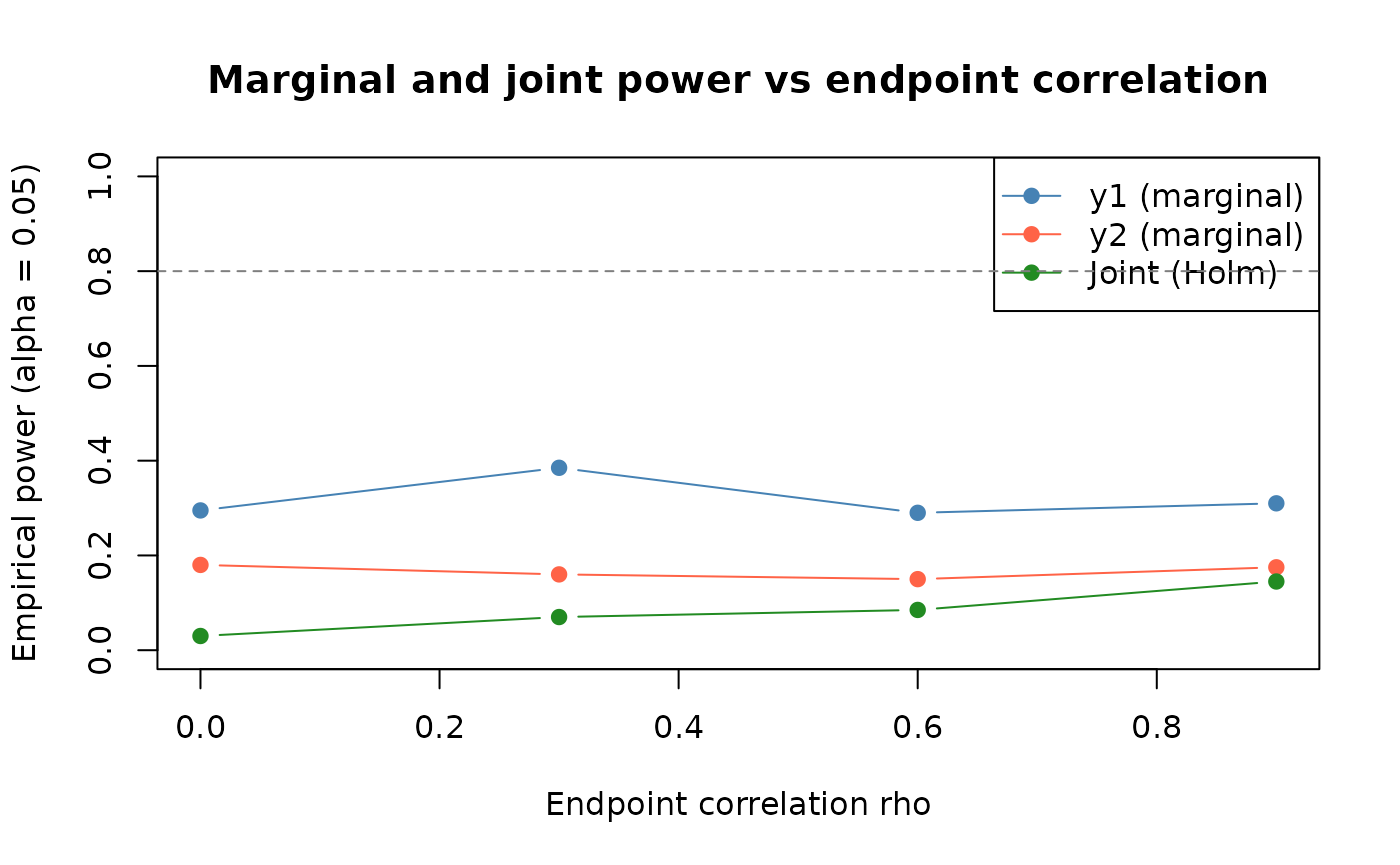
Next steps
- Example 3 - adds a time-to-event endpoint alongside the continuous one
- Population - endpoint data setup for continuous, binary, and time-to-event outcomes
-
Enrollment and Dropout - piecewise
enrollment with
deterministic_schedule()